
What you don’t see in business often hurts the most, as risks don’t really knock before they come crashing down your business. Many strong companies have fallen as a result from these missed risks.
Missed opportunities or reputational damage aren’t anything inevitable. Using enterprise risk management or ERM, you can easily spot risks before they spot you. That’s exactly what we cover in this blog post, along with its key elements. We will also show you how companies put it into action and how you can too.
What is Enterprise Risk Management Really About?
Enterprise risk management is a way for companies to look at all possible risks (financial, operational, reputational, even cyber threats) in one connected view instead of treating them as separate issues. It helps you answer three big questions:
- What could go wrong?
- What’s the impact if it does?
- What can we do right now to avoid or reduce it?
ERM also gives leaders the confidence to take smarter risks, knowing the potential consequences have been thought through. We will come back to this when we look at practical risk management techniques later on.
Why Your Business Can’t Afford To Skip ERO
Every business has risks, whether you admit them or not. Some risks are obvious, like cash flow issues or supply chain delays. Others creep in quietly, like data breaches or employee turnover, until they cause bigger disruptions.
The problem isn’t only the risks themselves. It’s the ripple effect. A single overlooked issue in operations can trigger compliance headaches, customer dissatisfaction, and revenue loss all at once. This is why companies who invest in ERM are actually creating stability and trust, which later becomes a competitive advantage for them.
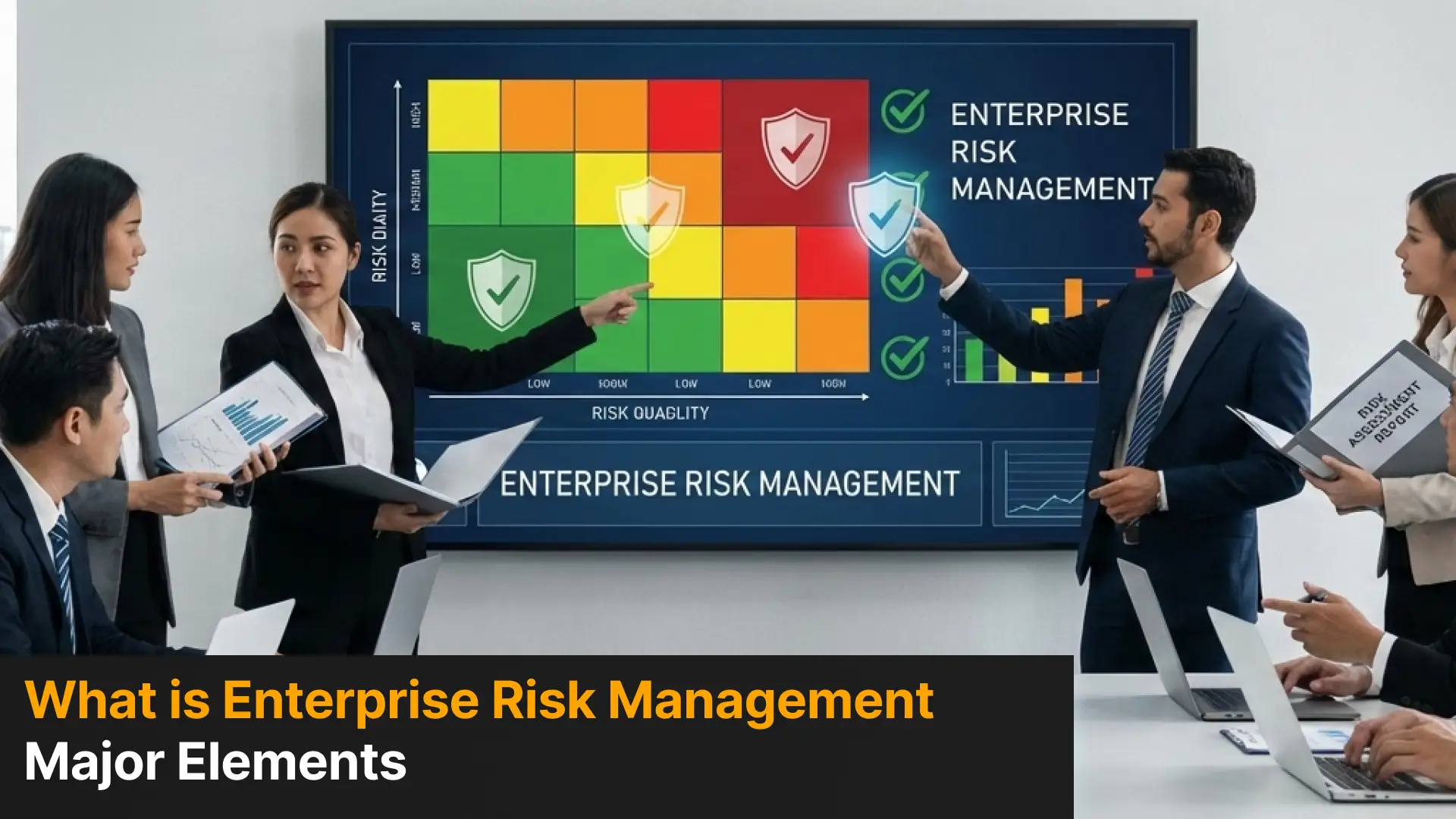
Major Elements of Enterprise Risk Management
These are the major elements of enterprise risk management:
Risk Identification: Seeing What Others Miss
List the risks. This first step sounds simple enough. But identifying risks goes beyond obvious scenarios. It involves workshops with teams, scanning industry trends, monitoring competitors, and even reviewing past near-misses.
When you cast a wide net, you spot risks that others often overlook. This connects directly to the next step of risk assessment. Because identifying without measuring is plain guesswork.
Risk Assessment: Measuring Impact Before It Happens
Assessment puts weight on each identified risk. Which one could damage reputation the most? Which could drain finances overnight? Businesses often use scoring systems to rank risks by likelihood and impact.
This is the stage where you start prioritizing as a leader. After all, not every risk deserves equal attention. And once you have got the top priorities nailed down, the conversation naturally shifts to mitigation.
Risk Mitigation: Turning Strategy Into Safeguards
Mitigation is where planning meets action. It’s when you build safeguards. For example, creating backup suppliers to handle disruptions, or putting cybersecurity protocols in place before hackers even try.
Risk Monitoring: Keeping the Radar on
Risks don’t stay the same. A plan that worked last year might already be outdated today. That’s why ERM includes continuous monitoring. It means tracking new risks as they emerge, reviewing whether current strategies are working, and updating them regularly.
Risks need to be reported across all levels of a business, so everyone understands what’s changing and what actions are being taken. That naturally ties into the final piece: governance.
Governance And Reporting: Setting the Tone At The Top
Risk management is an operational duty. Leaders need to set an example by treating risk as part of every decision. Transparent reporting helps board members, executives, and even external stakeholders see that risks are being handled responsibly.
When governance is strong, ERM becomes part of how the business operates daily. And this is where many organizations turn to external partners for guidance, which brings us to how management consulting importance for businesses ties into ERM.
The Role Of Consultants in Enterprise Risk Management
Consultants bring fresh eyes. While internal teams may overlook risks, external advisors spot blind spots quickly. More importantly, they guide companies in applying ERM principles without making it overly complex or bureaucratic.
Our consultancy in UAE often focuses on building ERM systems tailored to local regulations and market dynamics. For some clients, this has meant creating clear reporting lines. For others, it has meant hands-on training in risk awareness. Either way, the value is in building resilience that outlasts the next crisis.
Put ERM Into Practice with Risk Management Techniques
Theory alone won’t get you far. Companies need practical methods. Some common risk management techniques include scenario analysis, stress testing financial models, and using technology for real time monitoring.
These are some risk management examples: A retail chain may test how a new tax regulation impacts sales projections. A logistics company might simulate disruptions at ports. A healthcare provider may assess how patient data risks affect trust and liability.
Each of these examples shows ERM in motion: identifying, assessing, mitigating, and monitoring in real-world contexts.
Why ERM is Worth The Effort
At the big-picture level, enterprise risk management gives you confidence. Businesses stop reacting out of panic and start acting with intention. Teams start working together, aligning their shared priorities. And most importantly, leaders stop seeing risk as something to fear, but as something to shape their strategies around.
That shift often determines which companies thrive long-term and which are remembered only as cautionary tales.
Wrapping it Up: ERM As YOUR Business Advantage
If you have read this far, you already know ERM is a discipline that helps businesses survive shocks and seize opportunities. Enterprise risk management keeps you prepared, no matter whether you are dealing with market volatility, cybersecurity concerns, or regulatory changes. And here’s where we step in.
Our team works with businesses in the UAE to design and implement ERM systems that fit their size, industry, and ambitions. We believe in risk management that actually works for your business, not against it.
Let’s build a safer, smarter, and stronger foundation for growth. Reach out to us today for a consultation.
FAQ: Enterprise Risk Management
What is enterprise risk management in simple terms?
It is a way for businesses to spot potential risks, measure how serious they are, and build strategies to reduce or avoid them before they cause damage.
Why do businesses need ERM?
Because ignoring risks doesn’t make them disappear. ERM helps prevent costly disruptions and gives leaders confidence to take calculated opportunities.
Can small businesses use ERM?
Absolutely. The approach can be scaled up or down depending on business size. Even simple ERM practices help small companies stay resilient.
How does ERM differ from traditional risk management?
Traditional methods look at risks in isolation. Whereas, ERM connects everything into one view so risks aren’t missed or duplicated.
What role do consultants play in ERM?
Consultants help design, implement, and maintain ERM systems tailored to your needs, offering outside perspective and expertise.